
Is Knob + Tube Really That Bad?
If you own an older home in Toronto, you've probably heard the words "knob and tube wiring" at some point — usually from someone who wasn't smiling when they said it.
Maybe it came up during a home inspection. Maybe your insurance company flagged it. Or maybe an electrician opened a wall, ceiling or junction box and found that part of your house is still running on wiring installed generations ago.
People tend to assume the worst the moment they hear the term, and we get it — "wiring from the 1920s" doesn't exactly sound reassuring. But the real answer is more nuanced than a flat yes or no.
What knob and tube wiring actually is
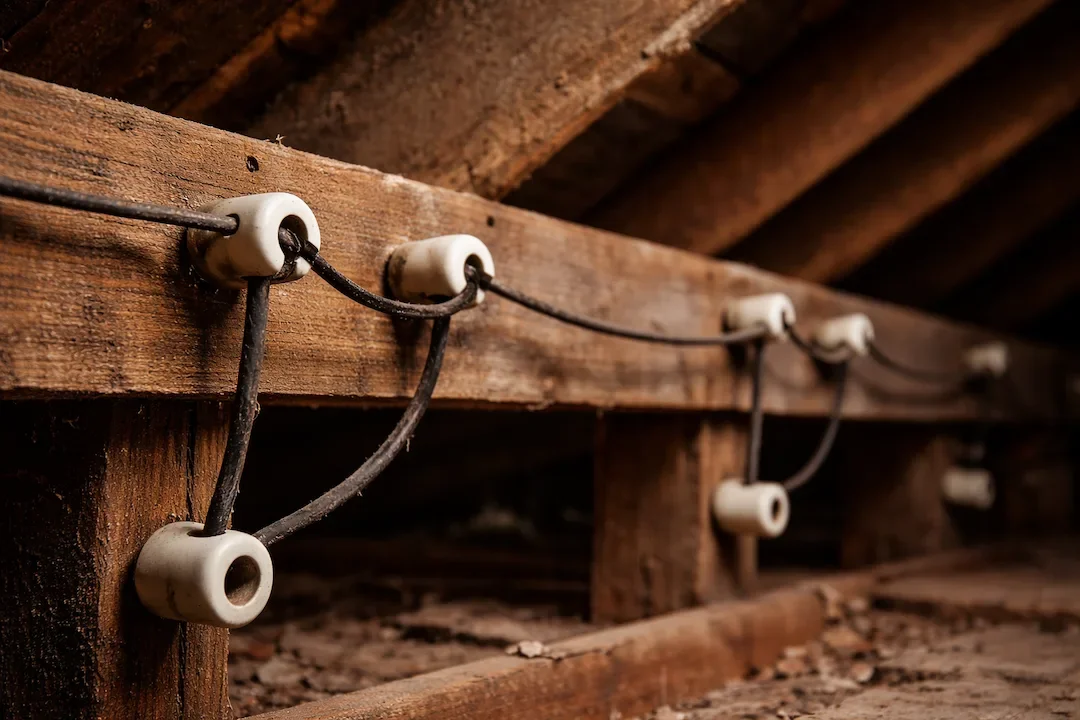
Knob and tube, often shortened to K&T, is an older wiring method common in Toronto homes built from the late 1800s through the first half of the 1900s. Instead of the bundled cables used in modern wiring, it uses individual insulated copper conductors, supported by porcelain knobs and routed through wood framing using porcelain tubes. That's where the name comes from. For its era, it was a completely normal, competent way to wire a house. The issue was never really the original installation.
The issue is everything that's happened to it since.
So is it actually dangerous?
Not automatically. A piece of knob and tube sitting untouched in a wall isn't a fire waiting to happen just because it's old. But Toronto homes have changed enormously since these systems were installed. Modern households run air conditioners, microwaves, espresso machines, hair dryers, space heaters — devices nobody was plugging in when this wiring went up. And decades of renovations, patch jobs and "quick fixes" can leave a system looking very different from how it started out. That's usually where the real problems live.
1. There's no ground wire
Modern wiring includes a dedicated ground path as a core part of the electrical safety system. Knob and tube typically has only a hot and a neutral conductor — no ground at all. This matters most when someone wants to install a modern three-prong outlet or plug in equipment that expects grounding. We've opened up plenty of Toronto homes where the outlet looks completely modern — three holes, clean faceplate — and once it's tested, there's no ground behind it whatsoever. The outlet is lying to you, basically. Three holes doesn't mean grounded.
2. It's genuinely old
A lot of Toronto homes with knob and tube are pushing or past the century mark. Think about everything that can happen to a house over a hundred years — heat, moisture, pests, renovations, the occasional questionable DIY project by a previous owner. Insulation around the conductors can go brittle or degrade outright. Honestly, the copper itself is rarely our concern. It's the condition of the insulation, and what's been done to the system since, that actually matters.
3. DIY renovations are often the bigger problem
This is something we run into constantly in older Toronto homes, and it's usually a bigger issue than the original wiring itself. The knob and tube install may have been done properly decades ago. Then life happened. Someone added a receptacle. Someone moved a light fixture. A basement got finished. A kitchen got remodelled without pulling permits. Eventually you end up with knob and tube, older copper, and modern wiring all tangled together in the same walls. Sometimes those splices are done properly and enclosed the way they should be. Other times we find junction boxes buried behind drywall with connections that would never pass an inspection today. This is also why checking your electrical panel alone won't tell you whether knob and tube is still active somewhere in the house — the panel and the wiring behind the walls can tell two completely different stories.
4. It wasn't built for how we live now
A house wired a century ago had nowhere near the electrical demands of that same house today. Portable AC units, home offices, gaming setups, big TVs, kitchen appliances running simultaneously — none of that existed when these circuits were designed. Older homes can also have surprisingly large areas fed by a small handful of circuits. We've traced circuits that wind through multiple rooms, feeding a dozen or more outlets and fixtures before finally looping back to the panel. That's not automatically unsafe. But it does mean you want to actually know what's connected to what before you assume everything's fine.
5. Insulation upgrades can create new problems
Knob and tube was designed to dissipate heat into open air around the conductors. That was the whole point of keeping it exposed on knobs rather than bundled tight. The trouble starts when later renovations — attic insulation, wall insulation, a full reno — change those original conditions without anyone accounting for the wiring underneath. If you're mid-renovation and knob and tube turns up, it's worth pausing to have it properly assessed before it gets buried behind new insulation and forgotten about for another twenty years.
6. Insurance can get complicated
For a lot of Toronto homeowners, this is actually the moment knob and tube becomes a real issue — not a wiring inspection, but a call from their insurance company. Some insurers restrict or refuse coverage for homes with active knob and tube, and may require an electrical inspection, repairs, or full replacement before they'll issue or renew a policy. It comes up during home sales too. A buyer falls in love with a house, then the inspection turns up active knob and tube, and suddenly everyone's asking the same questions: how much is left, where is it, is it still live, what will it cost to deal with. Those questions get a lot easier to answer once someone's actually looked.
Does the whole house need to be replaced?
Not necessarily, and this is where we'd push back on the instinct to assume the worst. Finding one section of knob and tube doesn't tell you the condition of the whole house. We see this constantly: a kitchen fully rewired during a past renovation, bedrooms still running on original wiring, a finished basement with new grounded circuits sitting a floor below untouched knob and tube on the second level. Before pricing out a full rewire, the first real step is figuring out how much knob and tube is actually still active. At Milestone Electrical, that's where we start — investigating the existing system, tracing what's still knob and tube, and identifying what's already been replaced. From there you actually know what you're dealing with.
Can it be replaced in stages?
Often, yes. Every house is different, but if part of the home has already been properly rewired, there's usually no reason to touch wiring that's already modern and compliant just because another section still has knob and tube. The goal is identifying what's actually still active and building a practical plan around it — sometimes that means specific circuits or rooms, sometimes it means a larger rewire makes more sense given how much original wiring remains. An assessment is really the only way to know which situation you're in.
Do you need a new panel too?
Not necessarily — the panel and the knob and tube wiring are separate issues. Plenty of older Toronto homes have upgraded panels sitting alongside sections of original branch-circuit wiring that were never touched. Whether you actually need a 100A to 200A service upgrade, a panel replacement, or just branch-circuit rewiring comes down to the condition and demands of the house — not the fact that knob and tube was found somewhere in it. We'd rather assess the whole picture than push a panel upgrade just because the word "knob and tube" came up.
How do you know if it's in your house?
There are a few visual clues, but honestly, the only reliable way to know is to have it inspected. Knob and tube sometimes shows up in unfinished basements or attics where it's exposed. But most of it lives behind plaster walls and ceilings, completely out of sight. Older two-prong outlets, odd electrical modifications, or a house that's clearly only been partially renovated are all signs worth paying attention to. None of them confirm anything on their own, though. Circuit tracing and proper testing is what actually tells you what's going on behind the walls.
Buying a house with knob and tube in it?
Don't panic. Don't ignore it either. Toronto's older neighbourhoods are full of homes that have been through generations of electrical work, good and bad. If an inspection flags possible knob and tube, get a licensed electrician to assess the system before assuming what the fix will cost. The gap between "a few remaining sections" and "the whole house needs rewiring" can be enormous — and you won't know which one you're looking at until someone's actually traced the circuits.
What replacement actually involves
It depends a lot on how the house is built. Generally, the process is tracing the existing circuits, figuring out what they feed, and running new wiring to those same locations. Electricians will usually route through basements, attics, closets and existing openings wherever possible to keep wall and ceiling damage to a minimum. That said, some access to walls and ceilings is often unavoidable — which is exactly why it's worth thinking about electrical work before you paint, or folding it into a larger renovation you're already planning. If you're already opening up walls and knob and tube turns up, that's usually the best window you'll get to deal with it properly.
The bottom line
Knob and tube isn't dangerous just because it's old. But between the missing ground, the limited capacity for modern loads, and however many decades of undocumented changes might be hiding behind your walls, it deserves a real look rather than a shrug. The biggest mistake is assuming everything's fine because the lights still turn on. The other one is assuming the whole house needs to be torn open before anyone's actually confirmed how much knob and tube is left. Find out what you're actually dealing with. Then decide what to do about it.
Knob and tube inspection and replacement in Toronto
If you've found knob and tube in your Toronto home — or you're eyeing an older property and want to know what you'd be taking on — Milestone Electrical Ltd. can help. We'll investigate the existing system, trace what's still active, and tell you plainly what's actually there. If work is needed, we'll put together a clear quote for it.
Contact Milestone Electrical Ltd. to arrange a knob and tube assessment or request a quote.
Serving homeowners throughout Toronto and the GTA.